
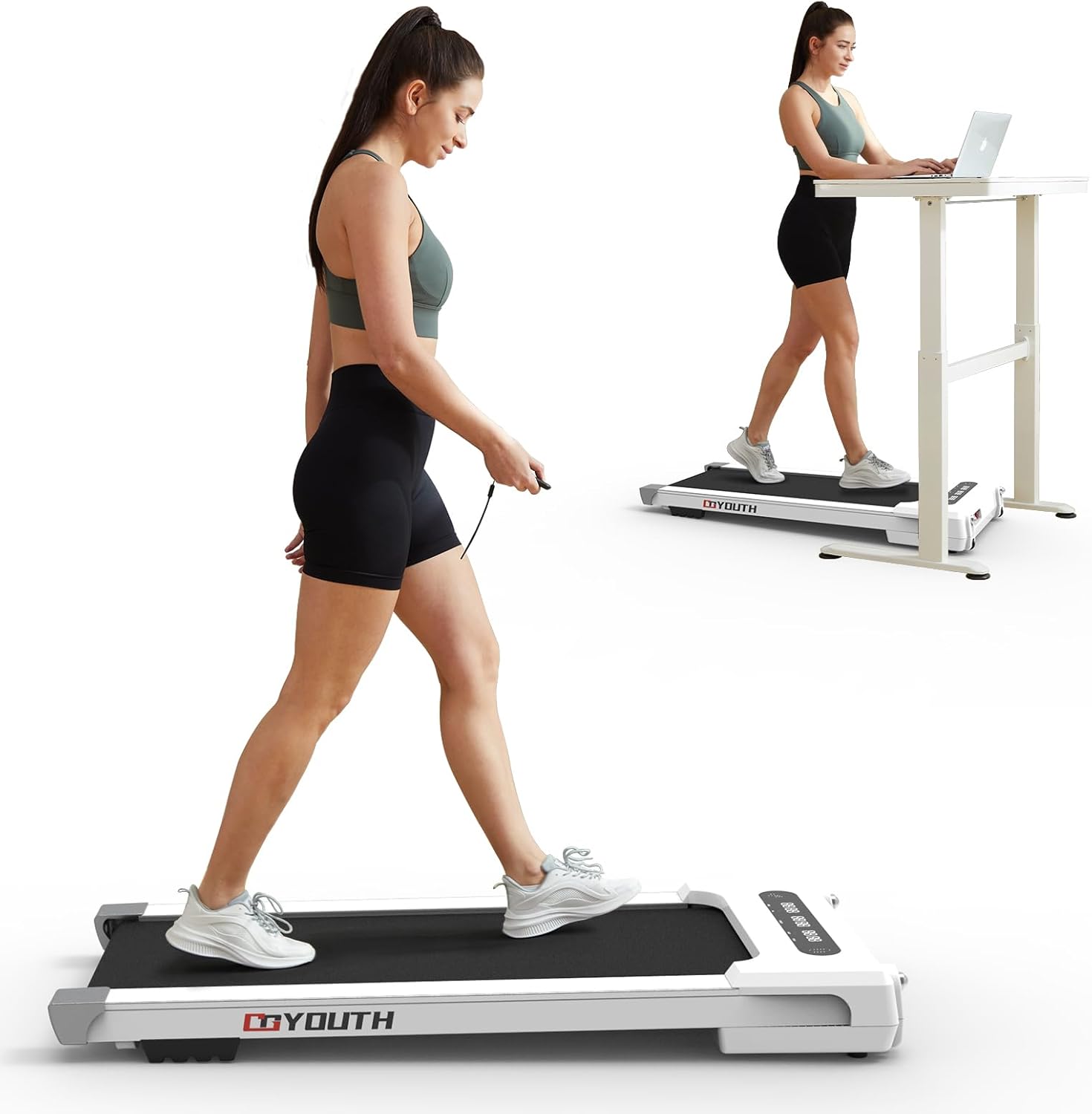
Best 2 in 1 under desk electric treadmill 2026
Description
Best 2 in 1 under desk electric treadmill 2026
# Best 2-in-1 Under Desk Electric Treadmill 2026: Walk More, Sit Less, Get Things Done
If you’re spending 8+ hours a day at a desk, your body is paying for it. A 2-in-1 under desk electric treadmill fixes that without blowing up your schedule or your living room.
This guide breaks down the best options in 2026, what to actually look for, and why the right pick depends almost entirely on how you plan to use it.
—
## What is a 2-in-1 under desk electric treadmill?
A 2-in-1 under desk electric treadmill does two things: walks slowly under a standing desk (typically 0.5 to 4 mph) and runs at higher speeds (up to 7.5 or 8 mph) when you fold up the handlebar and use it like a regular treadmill.
The “2-in-1” refers to that dual mode. Walk during calls. Run after work. Same machine, same footprint.
Most fold completely flat for storage. That’s the other big selling point for anyone working from a home office or apartment where every square foot counts.
—
## Why are 2-in-1 under desk treadmills worth it in 2026?
Remote and hybrid work didn’t go away. About 28% of U.S. workers now work remotely at least part of the time, according to a 2024 Gallup survey. That number has held steady since the post-pandemic reset.
Remote workers walk significantly less than office workers. No commute. No walking to the break room. No lunch runs. Some researchers estimate the daily step gap at 2,000 to 3,000 fewer steps per day compared to in-office work.
The World Health Organization recommends 150 to 300 minutes of moderate physical activity per week for adults. Most desk workers aren’t hitting that. A 2-in-1 walking treadmill under your standing desk is a pretty direct answer to a pretty specific problem.
—
## What should you look for when buying one?
### Does motor power actually matter?
Yes, and the distinction trips people up. For walking mode under a desk, a 2.0 to 2.5 HP motor is plenty. For running at 7+ mph, you want 3.0 HP or higher.
Watch for the CHP vs. peak HP gap. Most budget models list peak HP (maximum output under stress), not continuous HP. A 2.5 CHP motor is meaningfully more powerful than a “2.5 HP” motor that peaks there under load. Always look for the continuous horsepower rating when comparing machines.
### What speed range do you actually need?
For under-desk walking: 0.5 to 4 mph covers almost every use case. Most people settle at 1.5 to 2.5 mph while working without losing focus or spilling their coffee.
For jogging or running: you want at least 7 mph max speed. Some models go to 7.5 or 8 mph, which covers a solid running pace without needing a full-sized machine taking up half the room.
### How loud is too loud for a home office?
A treadmill running at 2 mph during a Zoom call is a real problem if it’s noisy. Good 2-in-1 under desk treadmills run at 60 to 65 decibels in walking mode. That’s roughly the volume of a normal conversation.
Anything above 70 dB at walking speeds will cause issues on video calls. Check user reviews for noise levels, not the spec sheet. Manufacturers tend to be optimistic with their own noise ratings.
### Weight capacity: where most buyers make the mistake
Most models support 220 to 300 lbs. If you’re over 200 lbs, pick a model rated at 265 lbs or higher. Running at max speed near the upper limit of a weight rating degrades the motor faster than most people expect.
### Belt width matters more than it sounds
Under desk walkers often run narrow belts (around 15 to 16 inches) to stay compact. That’s fine for walking. For running, a 17-inch or wider belt gives you enough room to run without feeling like you’re on a balance beam.
—
## Which are the best 2-in-1 under desk electric treadmills in 2026?
### WalkingPad A1 Pro
WalkingPad (made by Kingsmith) is the most recognized name in the under-desk treadmill category. The A1 Pro handles up to 10 km/h (about 6.2 mph) and folds in half for storage. It weighs around 28 lbs, which matters a lot if you’re moving it daily.
It’s whisper-quiet in walking mode and the app works reliably. The tradeoff: 6.2 mph isn’t a running speed for serious runners. For the average remote worker who wants to walk during the day and jog in the evening, this covers it well.
**Best for:** Remote workers who want a primarily walking machine with occasional light jogging.
### Urevo 2-in-1 Under Desk Treadmill
Urevo’s 2-in-1 is one of the better budget picks on Amazon. It consistently holds above 4 stars with a large number of verified reviews and handles up to 7.5 mph in running mode with a 265-lb weight capacity.
The console is basic. The app works without impressing anyone. Build quality sits a step below WalkingPad. But the price difference is real, and it does the core job without embarrassing itself.
**Best for:** Budget buyers who want a working 2-in-1 without paying for premium finishing.
### LifePro Pacer Treadmill
LifePro targets the fitness-minded buyer more directly. The Pacer has a 17-inch belt width, wider than most compact models, which makes running feel significantly less precarious.
It runs louder than the WalkingPad options at walking speed. Worth knowing if you’re using it in a small apartment with thin walls. But if running mode is something you’ll genuinely use 3 to 4 times a week, the Pacer earns its premium.
**Best for:** People who want the running functionality to be genuinely usable, not just listed on a spec sheet.
### Goplus 2-in-1 Folding Treadmill
Goplus makes a wide range of fitness equipment and their 2-in-1 folding treadmill sits comfortably in the mid-range. It handles up to 8 mph, supports 220 lbs, and the folding mechanism is one of the simpler ones to operate day-to-day.
No app connectivity on most versions. If you want basic, reliable, and affordable without paying for features you’ll ignore, Goplus is worth a serious look.
**Best for:** Buyers who want simplicity and don’t care about Bluetooth or app tracking.
### NordicTrack T Series (entry-level)
NordicTrack’s entry-level T Series isn’t marketed as an “under desk” treadmill, but it’s worth mentioning as a benchmark. It shows clearly what a $600-plus machine gets you in motor reliability, belt cushioning, and incline range compared to the compact 2-in-1 options.
If you’re on the fence about under-desk models and have the space, the NordicTrack T 6.5 S is a useful comparison point before committing to a compact machine.
—
## Are 2-in-1 under desk treadmills actually good for your health?
Yes, and the evidence isn’t thin. A 2023 study published in the *British Journal of Sports Medicine* found that light-intensity walking, including treadmill walking at desk speeds, significantly reduced sedentary time and improved cardiovascular markers in office workers over a 12-week period.
Walking at 1.5 to 2 mph for 2 hours during a workday burns roughly 200 to 300 extra calories compared to sitting. Over a month, that adds up to a meaningful difference without changing your diet or exercise routine.
The cognitive angle holds up too. A Stanford study found that walking boosts creative output by around 81% compared to sitting. Walking meetings became a thing for a reason.
Most people who commit to a walking treadmill report the same two outcomes: they move more during the day (expected) and their 3 pm energy crash shrinks or disappears (less expected, but consistent across user reports).
—
## What desk height do you need?
Most under desk treadmills raise your standing height by 4 to 6 inches (the thickness of the machine plus any platform elevation). A proper standing desk height for treadmill use lands around 40 to 44 inches from the floor for most adults.
Standard electric standing desks go up to 47 to 48 inches, so you’ll typically have enough range. If you’re using a fixed-height desk set to a sitting height of 29 to 30 inches, it won’t work. Measure your setup before buying.
—
## How much should you spend?
Under $300: You’re looking at walking-only or very limited running models. Fine for a low-commitment experiment.
$300 to $500: This is where most of the best 2-in-1 options live. WalkingPad A1 Pro, Urevo, and Goplus all land here depending on the sale.
$500 to $800: You get meaningfully better motor quality, belt cushioning, and noise reduction. LifePro Pacer and a few others sit here.
Above $800: You’re crossing into full-sized treadmill territory. Probably more than you need if the under-desk walking function is the main draw.
—
## How do you actually use one without losing focus?
Walking at 1.5 to 2 mph during focused work takes about 2 to 3 days to adjust to. Most people can type at full speed within a week. Walking and reading is immediate. Walking and drawing or handwriting is harder and probably not worth it.
Video calls are fine at walking speed if your machine is quiet enough. The camera shake is minimal. Most people on the other end can’t tell.
Start with 30 to 45-minute walking sessions. Jumping to 4-hour walking workdays usually ends with sore calves and a week off the machine. Build up gradually and it sticks.
—
## Final verdict: which one should you buy?
For most remote workers, the WalkingPad A1 Pro hits the right balance: quiet enough for calls, compact enough for a home office, and capable enough for light jogging. It’s the default recommendation for a reason.
If budget matters more than build quality, Urevo’s 2-in-1 delivers solid value. If you’ll actually use the running mode regularly, the LifePro Pacer is worth the extra cost. And if you want basic reliability without paying for app connectivity, Goplus gets the job done.
The most important feature of any 2-in-1 under desk treadmill is the one you’ll use consistently. A machine that stays folded in the corner is just expensive floor furniture.
—
*Sources: Gallup State of the Workplace 2024, World Health Organization Physical Activity Guidelines, British Journal of Sports Medicine (2023), Stanford study on walking and creativity (Oppezzo & Schwartz, 2014).*